
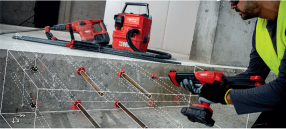
Understand requirements, constaints, and available resources
Design requirements
Design of post-installed reinforcing bar connections requires that the type, size, spacing and quantity be established for the connection. This is typically based on either direct calculation of section forces or a requirement to match existing reinforcement. Density and sizing of dowels for shear transfer between new overlays on existing structural elements such as slabs and walls may be based on other considerations. Additional design considerations may include:
- loading type (sustained, seismic, shock)
- fire requirements
- corrosion resistance
- detailing requirements based on element type (integrity reinforcement, etc.)
Jobsite constraints
Prior to designing a post-installed reinforcing bar connection, identification of the jobsite constraints is vital. Key parameters that should be accounted for in the design may include:
- existing reinforcement layout as given in drawings and confirmed onsite using detection equipment
- required proximity of new to existing reinforcing to satisfy conditions for non-contact lap splices, etc.
- drilling method (hammer drill, core drill, Hilti Hollow Drill Bit)
- orientation of connection (downhole, overhead, etc.)
- ambient air and concrete temperatures at time of installation
- type and condition of the concrete e.g. cracked, carbonized • access and geometrical constraints
Required bond length
In general, the required bar embedment is based on the development length and splice provisions of the code.Where geometrical or other practical constraints dictate, alternate procedures may be appropriate to establish bond length. The size of the bar and required bond length may also guide the type of adhesive system to be used. Adhesives with longer working time (e.g., Hilti HIT-RE 500 V3) are usually more appropriate for large diameter bars in combination with deep holes, whereby for small and medium bar diameters and shorter holes, systems with accelerated cure (e.g., Hilti hybrid adhesive HIT-HY 200) can increase efficiency. These considerations may be affected by the anticipated job site conditions (e.g., access and ambient air and concrete temperatures).
Connection detailing
The location of post-installed reinforcing bars with respect to existing reinforcement should be clearly indicated in the project documentation. In addition, the specifications and details may include:
- adhesive system
- bar type and size
- required bar embedment
- hole diameters and drilling method(s)
- requirements for preparation/roughening of existing concrete surface
- instruction on inviolability of existing reinforcement and embedded items as required
- requirements on training/certification of installers as required
- inspection/proof loading requirements
System specification
Specifications should correlate to the design assumptions and the specific job site requirements addressed in the project documentation. Substitutions based on a simple specification of bond stress may not be sufficient to ensure proper execution of the work.
System selection
The suitability of Hilti adhesive systems for post-installed reinforcing bar applications has been verified for a wide variety of jobsite parameters. Nevertheless, the choice of the appropriate Hilti adhesive system and injection equipment for post-installed reinforcing bar installations is to a degree dependent on jobsite parameters.

For example, if a rapid-cure adhesive is specified for a large and deep bar installation, the time required to inject the adhesive may exceed the working time of the polymer. In such cases it may be impossible to insert the bar fully into the hole and/or the adhesive may not reach full strength. In particular, when adhesives are delivered, in bulk quantities into a large drilled hole, the exothermic reaction associated with polymerization can result in excessive temperature rise which in turn can result in accelerated cure, further complicating bar installation. Adhesives which have not been properly verified for post-installed reinforcing bar applications should not be used for structural or safety-related applications.
Conversely, injection of adhesives under sub-zero conditions can result in elevated viscosity, likewise making manual adhesive injection and bar installation difficult or impossible.
Basic considerations associated with adhesive selection should include:
- Can the adhesive be injected and the reinforcing bar installed within the gel time of the adhesive?
- Is the appropriate injection equipment available, including all necessary accessories, to ensure correct dispensing and mixing?
- Is the adhesive suitable for the concrete temperature and moisture conditions, hole orientation and drilling method?
- What mechanical effort or equipment is required to inject the adhesive and to installed the reinforcing bar into the adhesive-filled hole?
- How will the bar be held in place during adhesive cure?
Jobsite conditions
Jobsite constraints impact both design values (bond strength) as well as installation effectiveness.
System selection is therefore dependent on the combination of design requirements and jobsite constraints. Note also that each system is offered with a variety of options for injection in terms of cartridge size and injection equipment (manual vs. battery or pneumatic drive). Additionally, Hilti offers specialized drilling systems that substantially reduce hole cleaning requirements.
An aspect of system selection that is sometimes overlooked is the absolute volume of adhesive that must be placed in the hole. Large diameter and very deep holes may require a greater volume of adhesive than can be reasonably placed even with pneumatic delivery equipment. Furthermore, injection of large quantities of adhesive can result in excessive heat generation due to the exothermic nature of polymerization. These issues should be carefully considered for cases outside of the normal range of post-installed reinforcing bar applications.
Please visit our Rebar Design Center for information regarding post-installed rebar applications.
Hilti is the first manufacturer to offer a software solution for the post-installed rebar application. PROFIS Rebar is a web based design software that allows engineers to design post-installed rebar using the only two approved adhesive anchor systems on the market, HIT-HY 200 and HIT-RE 500 V3. PROFIS Rebar calculates tension and compression lap splice lengths, development lengths for starter bars, development lengths for special moment frames and special structural walls, and development lengths for shear dowels. PROFIS Rebar also calculates post-installed reinforcing bar embedment based on research conducted using shear friction theory.
