
HILTI Kwik-X, A New Anchoring Technology
The First Innovation in Dual Action Screw Fastening Technology
HILTI Kwik-X, A New Anchoring Technology
Given the large variety of anchor systems available on the market today, designers or installation professionals may find it difficult to select the appropriate anchor for a specific application. Typically, for post-installed anchoring applications, the choice is between mechanical anchors or chemical anchors where the anchoring system is selected considering the design needs, jobsite application, and construction conditions.
Fig 1. Below provides common differences between mechanical and chemical anchors.

Fig 1: Characteristics of mechanical vs. chemical anchoring systems
In general, the benefit of mechanical anchors is the simplified installation process compared to chemical anchors. Additionally, mechanical anchors may be more economical than chemical anchors, but are considered less flexible in design and installation due to limited diameters and limited embedment depths.
The benefit of chemical anchors is they yield higher loads, and the anchoring system can often accommodate smaller edge and spacing distances (especially when compared to expansion anchors). However, the use of chemical anchors is considered more complex due to the influence of temperature and water, and extensive hole cleaning procedures.
Consequently, it can be said that there is a demand for an anchoring technology combining the benefits – as much as possible of both anchoring technologies – mechanical anchors, and chemical anchors.
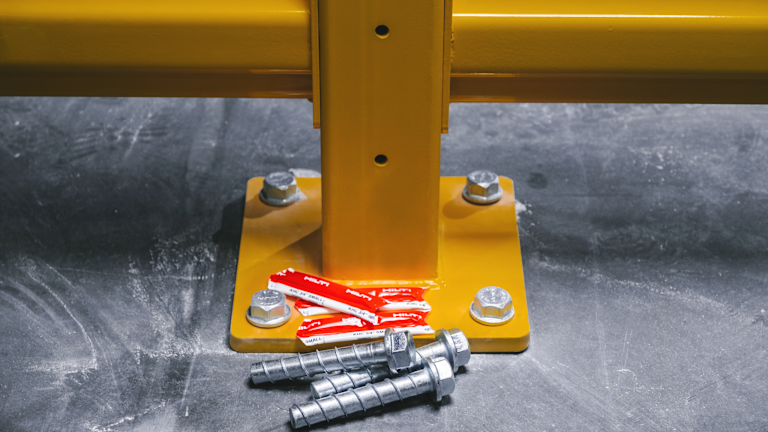
The Hilti Kwik-X Dual Action Anchor does just that with the combination of the KWIK HUS-EZ (KH-EZ) mechanical screw anchor with the Kwik HUS Capsule (KHC) containing a specialized two-part adhesive.
The dual action anchoring system employs a concrete screw with a hexagonal head in conjunction with a foil capsule filled with the constituent bonding materials of an injection system, see Fig 2.

Fig 2: Kwik-X dual action anchor
The KHC of the Kwik-X Dual Action Anchor system contains polymer resin, hardener, and aggregates in a defined mix ratio. The KHC is placed in a drilled hole produced by either a hammer drill or diamond core drill. The concrete screw is driven through the capsule using an impact drill (refer to MPII for installation instructions, as they vary per KH-EZ material/coating selection) When driving the concrete screw into the hole the KHC is shredded but also compressed. The resin hardener and aggregate are mixed and fill the annular gap around the concrete screw as the thread cuts into the wall. Simultaneously cracks around the anchor are filled with resin, see Fig. 3.
The Kwik-X Dual Action Anchor’s load transfer mechanism is based on mechanical interlock and friction. The adhesive from the KHC increases the area of the mechanical interlock of the threads as they cut into the surrounding borehole, and as well as filling the annular space around the screw. Following the full cure of the adhesive there is friction interlock between the screw and the cured adhesive.

Fig 3: Threads cut by Hilti KH-EZ screw and Hilti Kwik-X dual action anchor (Hilti KH-EZ concrete screw with Hilti Kwik-HUS Capsule
KWIK-X brings key benefits to the following applications:
Hilti Kwik-X is most applicable for structural baseplate connections, as well as equipment and machinery attachments in normal weight or lightweight cracked or uncracked concrete under static, quasi-static and seismic loading. The benefit of Kwik-X is the dual action function (micro-keying & adhesion) adapting the performance to the application requirements.

Fig 4: Hilti Kwik-X for secondary structural attachments, machinery, and equipment
Hilti KWIK-X Dual Action Anchor may also be used in non-structural safety related applications. For example, the attachment of handrails, guardrails, roofs, and lightweight steel structures to new or existing structures. For such applications the Hilti Kwik-X fastening system provides you the possibility of designing with smaller edge and spacing distances while also providing installers an anchor that is easier and faster to install that is still completely removable, see Fig. 5.

Fig 5: Hilti Kwik-X may be removed and re-installed into the same borehole up to one time per the MPII. Removability and re-installation is not covered in the Kwik-X Dual Action Anchor Evaluation Service Report (ICC-ESR 5065)
Poor performance of fastenings for equipment and anchoring systems can contribute to damage and productivity loss. The dual action technology and removability of KWIK-X when changing the position of the equipment provides you the advantages of being more flexible against functional changes.
Summary
The new Hilti KWIK-X Dual Action Anchor is the first of its kind post-installed anchor that combines the advantages of chemical anchors with the advantages of mechanical anchors.
Hilti KWIK-X brings a productive solution with its easy method of installation in conjunction with high-capacity performance helping meet the needs of both designers and contractors. It pushes the boundaries compared to traditional injectable adhesive technology by offering extended base material temperature range for installation down to -18°F (-28°C) for cold weather installations, and offers flexibility to accommodate design changes by offering a removable and re-usable solution.
For contractors, KWIK-X eliminates common pain points: no lengthy cure times, minimal borehole cleaning (see MPII installation requirements based on KH-EZ material/coating selection), and no additional torquing beyond the use of an impact wrench.
The best of both worlds for designers and contractors
… brought to you by Hilti.